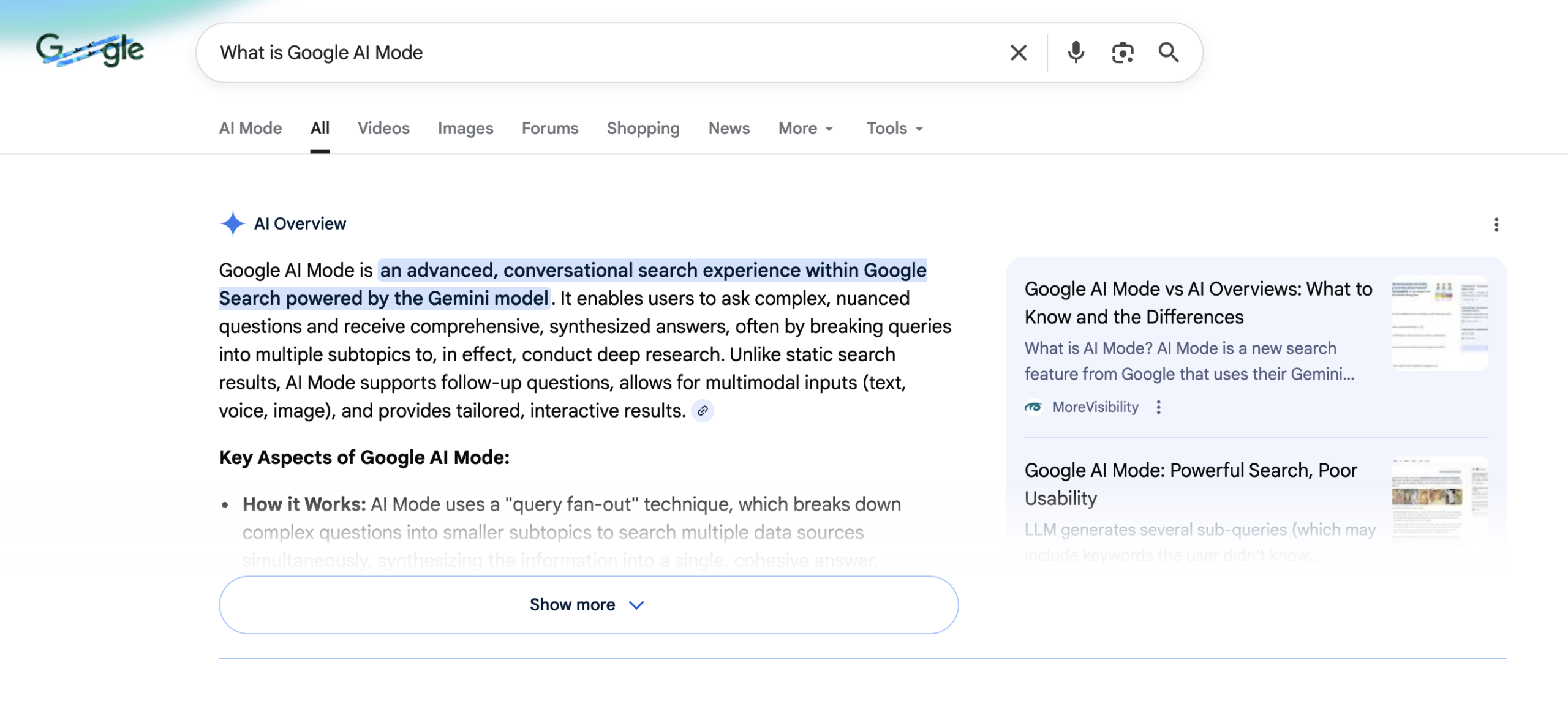
Google AI Mode
Google’s AI-driven search experience is changing how websites are evaluated, surfaced, and recommended.
Instead of simply returning a ranked list of pages, Google increasingly uses generative AI to summarize information, interpret intent, and present synthesized answers directly in search results.
For businesses, this means visibility is no longer just about ranking. It is about being selected as a trusted source.
What Is Google AI Mode?
Google AI Mode refers to AI-enhanced search experiences that generate summaries, recommendations, and contextual responses based on multiple indexed sources.
Unlike traditional search results that list links, AI-powered results interpret content and present consolidated information.
To appear in these AI-generated experiences, your website must:
- Be crawlable and indexable
- Demonstrate topical expertise
- Provide structured, context-rich content
- Show authority signals
AI systems prioritize clarity and depth over keyword repetition.
How AI Search Evaluates Websites
AI search does not operate on keywords alone. It evaluates meaning, structure, and authority.
Key signals include:
1. Topical Depth
Websites that cover a subject comprehensively win the reference on AI Search. A single article about SEO is less authoritative than a structured cluster covering technical SEO, AI optimization, schema, and performance strategy.
2. Semantic Structure
Clear headings, logical hierarchy, and contextual internal linking help AI systems understand relationships between topics.
Poorly structured content is harder for AI to interpret and summarize accurately.
3. Content Quality
Google’s documentation confirms that AI-generated content is acceptable if it is helpful and created for users.
Thin, repetitive, or mass-produced content weakens trust signals.
4. Technical Foundations
Crawlability, page speed, mobile performance, and clean HTML structure remain critical.
AI cannot surface what Google cannot reliably index.
Why Traditional SEO Alone Is Not Enough
Traditional SEO focuses on rankings and backlinks. While those still matter, AI search has a broader requirement: authority recognition.
To compete in AI-enhanced results, businesses must move beyond:
- Publishing disconnected blog posts
- Targeting isolated keywords
- Rebuilding websites without SEO architecture
Instead, they must build structured expertise around defined service areas.
Authority is accumulated through consistency and depth.
What Businesses Should Do Now
To prepare for AI-driven search, focus on:
Build Topic Clusters
Create structured content around core service themes instead of publishing unrelated articles.
Improve Technical Infrastructure
Ensure your website is optimized for crawlability, speed, and mobile-first indexing.
Use Structured Data
Schema markup clarifies entities and strengthens contextual signals.
Strengthen Internal Linking
Connect related pages logically to reinforce subject relationships.
Prioritize Quality Over Volume
AI systems reward usefulness, not content quantity.
How This Impacts Local Businesses
AI search can level the playing field.
Small and mid-sized businesses can compete with larger brands if their websites demonstrate clearer topical authority within a defined niche.
Localized expertise combined with structured content often outperforms broader but unfocused domains.
The Strategic Opportunity
The shift toward AI-powered search creates an opportunity for businesses willing to invest in SEO infrastructure.
Websites built with clarity, technical integrity, and industry specific content are more likely to be referenced, summarized, and recommended.
At Des Moines Creative, SEO is approached as long-term infrastructure rather than short-term traffic generation. That means building websites designed for both traditional rankings and AI interpretation.
Search is evolving.
Businesses that adapt their SEO strategy to align with AI-driven evaluation will build durable visibility, stronger trust signals, and long-term domain authority.